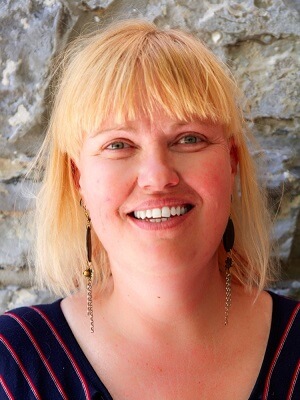
Psychologist
·
Eghezée (warêt-la-chaussée)
·
Belgium
Ludivine Guelette
Next available appointments
04-11-2026
French
Presentation
Hello, I am Ludivine Guelette, Gestalt Psychotherapist for children and adolescents.
Bachelor’s degree in Clinical Psychology
Master’s degree in Clinical Psychology
Long training in “Gestalt therapy” at the Belgian Gestalt Therapy Institute
Training in “Gestalt therapy and children”, IBG and EPG
Training in “Sandplay practice”
In addition to being a psychotherapist, I am also a facilitator and trainer in creative expression workshops. Art and play, in all their forms, are part of my life.
Gestalt therapy is at the center of my approach
Gestalt therapy focuses on what is happening in the present, “here and now,” and on contact with the Other and the environment.
It is experiential, that is to say it concerns lived experience. It is part of the humanistic, existential and relational current of psychology.
We are in a chronicle where things are constituted in a process. It is an unfolding of something that will come to an end (a cycle of contact).
It is a shared experience in which the therapist knows nothing in advance; like their patient, they are in a new experience, engaged, like them, in a new encounter, opening toward greater awareness of what is happening, of what is being lived.
On the occasion of the therapeutic situation, Gestalt therapy aims to make the patient increasingly aware, to allow them to experience something different / another experience / new possibilities and to awaken their creative potential. It involves responsibility and enables transformation.
I use sandplay as a tool
I choose to work with mediators and, over the years, my choice has turned toward SANDPLAY.
Sandplay (“Sandplay Therapy” developed in 1960 by Dora Kalf, Jungian psychotherapist and psychoanalyst), used as a therapeutic tool, consists in mobilizing the person’s creative energies.
The shaping of their inner world and its images is done through the manipulation of sand, figurines and stories. Sandplay opens up, shifts perspectives, and surprises.
Our means of expression are multiple. The mediators are the unknown, the imaginary, the new, creativity… offered to experience within the therapeutic encounter.
They allow us to reach buried, little-known parts of ourselves, in a new language where emotions and sensations find their way (when words are missing).
It is a playful, non-interpretative tool that allows one to express oneself, give shape to the unsayable, set in motion what is frozen, develop imagination and creativity, gain awareness and grow...
Within a safe framework, I offer the child/teen a special space where they have the opportunity to
give form to their worries, frustrations, desires, needs, questions… But also to their way of being in relationship with themselves, with others and with the world.
Concretely, the child/teen? the parents?
The child as an individual is connected to the members of their family and is dependent on them. The parents make up their close, everyday environment. The child’s therapy therefore cannot be considered without the involvement of the parents, both in terms of commitment and trust, and in terms of a better understanding of what is happening for the child.
Moreover, it is also necessary for the child to have access to a therapeutic space for personal expression that is supportive and safe.
The first session is held with the parents, without the child.
Then, it will depend on the situation. The space may be mainly reserved for the child/teenager with certain sessions including the parents to review things and hear what is going on. It may be that we alternate more regularly. It may also be that we do either parent sessions or parent-and-child sessions.
It may be that older children or teenagers themselves request psychotherapeutic support and that it therefore starts directly with them, without the parents. At first.
I meet the child/teenager every 15 days (sometimes every week at the beginning, such as the first 3 sessions).
This may change towards the end of the support or depending on schedules, such as school holidays.
This presentation was translated by DocSelect.
Issues addressed
- Anxiety attacks
- Smoking cessation
- Burnout
- Alcohol dependency
- Drug dependency
- Depression
- Grief
- Chronic pain
- Serious illnesses
- Weight loss
- Phobias
- Trauma
- Aggressiveness
- Anxiety
- Relationship difficulties
- High potential
- Hypersensitivity
- Career guidance
- Sexual disorders
- Medically assisted reproduction (IVF)
Specialties
- Clinical psychologist
- Gestalt therapist
- Teenagers
- Child
Pickup starting at
5 - 8 years
9 - 12 years
13 - 16 years
Adolescents 17 and older